
From Ivory Tower to Impact: Enterprise Architecture

Brendan Hartmann
Brendan Hartmann is a solution architect with 25+ years' experience across solution, domain, and enterprise architecture, delivering complex ICT and business transformations for government and private-sector clients, with a focus on cloud, data, and integration design.
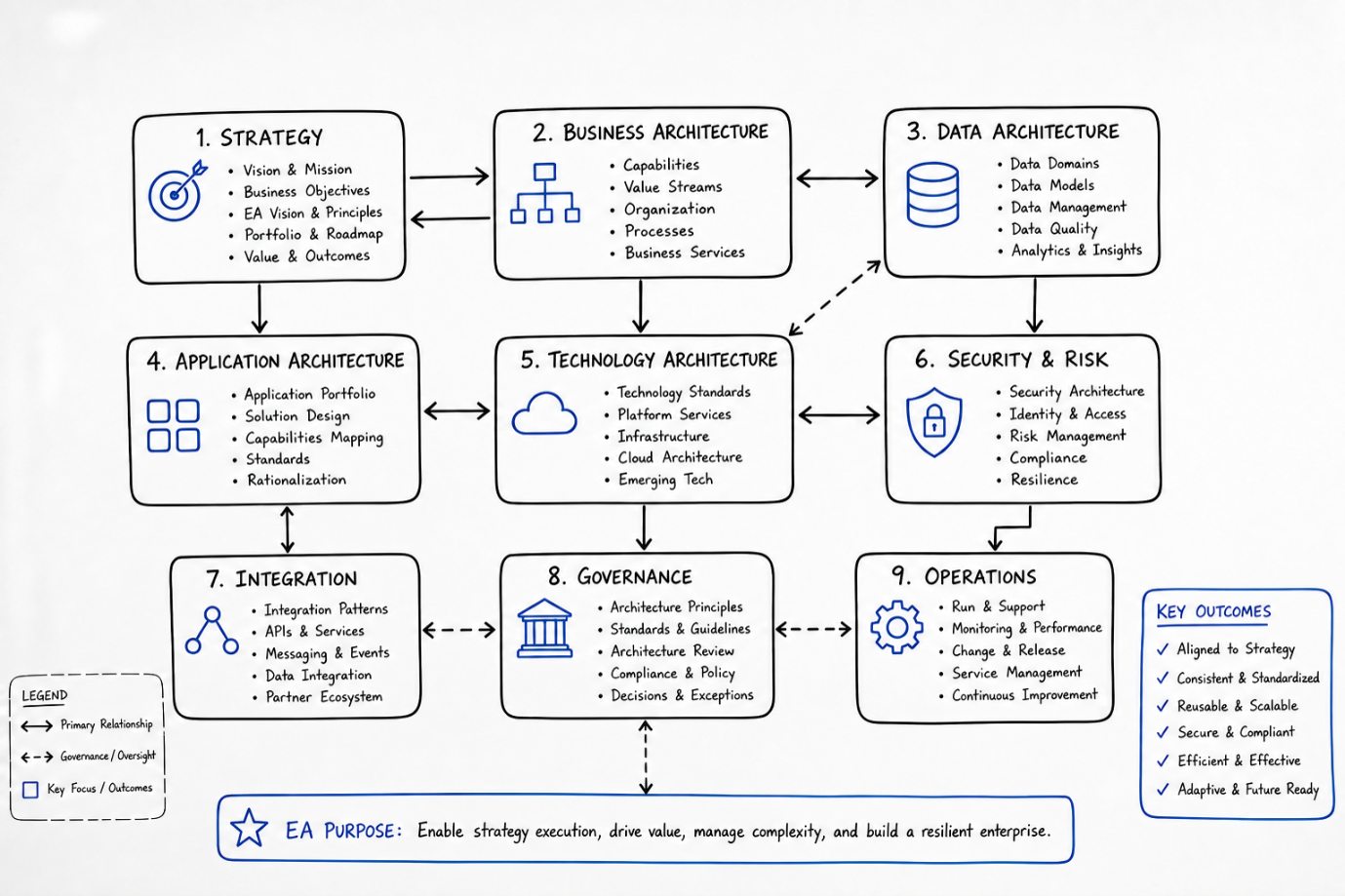
Enterprise Architecture is often perceived as existing in a gilded ‘ivory tower,’ producing complex models and spider-like diagrams that are hard to read. They are impressive shelf-fillers, but all too often they are relegated to the dark recesses of SharePoint folders where they effectively rot.
This is the first in a series of articles demonstrating how to look beyond the abstract nature of Enterprise Architecture and discover how it can be used to reduce duplication, improve capability visibility, rationalise systems and processes, and make better investments that support real business outcomes.
This first article will focus on one of the core artefacts of Enterprise Architecture: the capability model.
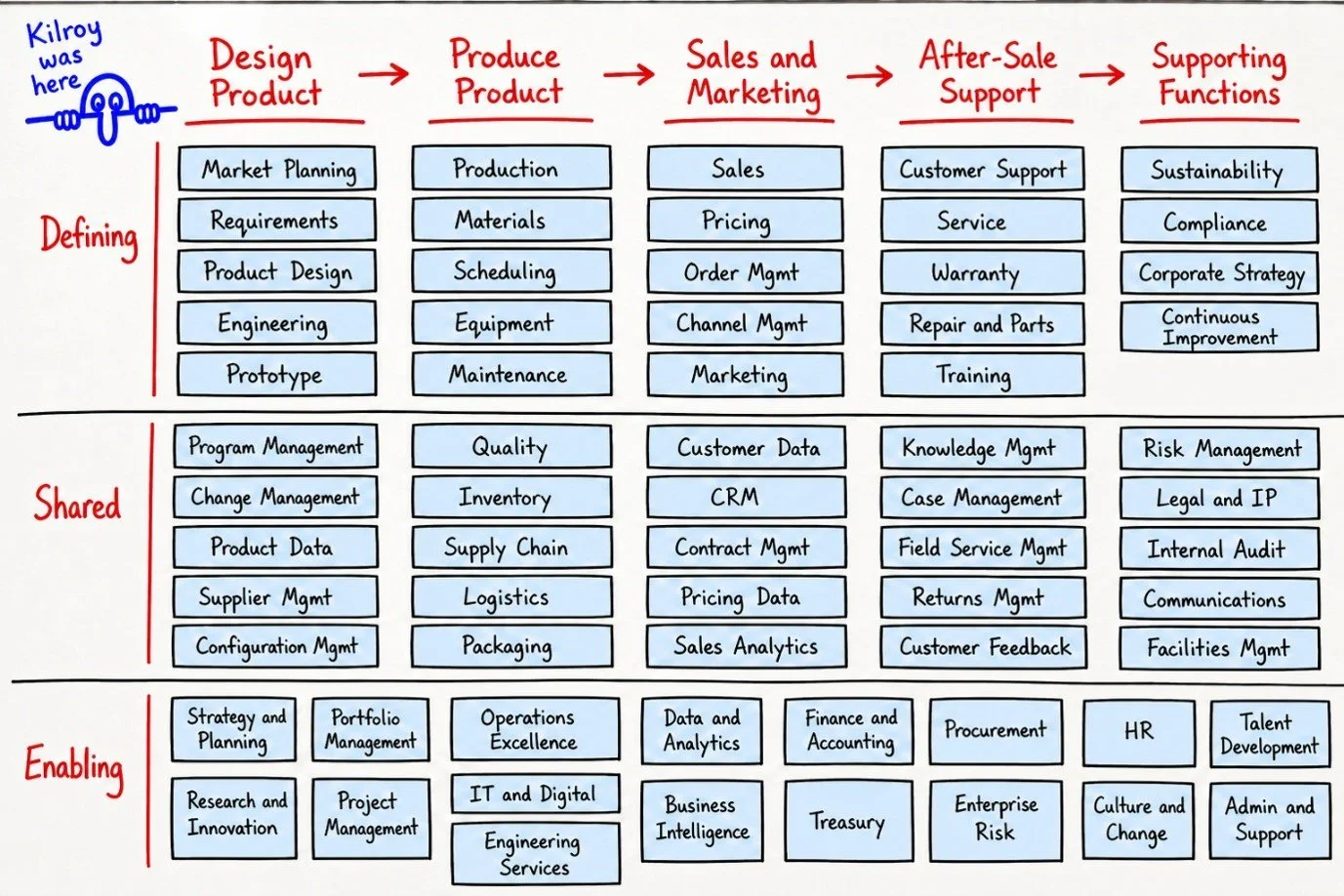
Enterprise Architecture Capability Model
A capability model is among the first artefacts that most Enterprise Architects will recommend. The capability model is a simple map of what your business must be able to do to create value. It is intentionally decoupled from your organisational structure and operating model to give a stable view of what capabilities you need to operate even when teams and structures change. It helps move the conversation from ‘Who owns this team?’ towards ‘What value does this capability deliver?’ or ‘What IT systems are required to enable this capability?’ That shift helps identify duplication or gaps.
Using this capability model as an example, I will describe how to interpret this diagram.
The columns are laid out to describe the core value chain of the business. One benefit is that when you change one capability, the potential knock-on effects are easier to visualise. A simple example is that a change to ‘Product Design’ can have ripple effects on Production, Sales and Support.
The vertical bands (Defining, Shared and Enabling) group capabilities that shape the business model (Defining), those that are leveraged across multiple parts of the value chain (Shared), and underlying capabilities that are required to enable the organisation (Enabling).
From a practical perspective, this model can be used to identify whether the organisation is over-investing in operational capabilities while under-investing in defining capabilities. It can also highlight where shared capabilities can be strengthened once and reused many times rather than being duplicated in silos.
At a strategic level, the capability model can also be used to frame conversations about competitive advantage and differentiation. Each capability box represents a discrete capability that can be rated (Strong, Average, Weak), benchmarked and targeted for improvement or transformation. For example, if ‘After-Sale Support’ capabilities are weak, but customer experience is a stated strategic priority, the map makes that misalignment visible and concrete. It also helps with scenario planning: when considering a new digital channel, acquisition, or product line, the CEO can trace exactly which capabilities will be affected and whether they are ready, need investment, or can be leveraged for scale.
The capability map also becomes a neutral, shared language between the CEO, executives and boards for discussing change without immediately getting bogged down in structure or personalities; instead of debating which department ‘owns’ what, the focus shifts to which capabilities we need to be great at, which ones can be just ‘good enough’, and how we should sequence improvement over time. That supports clearer strategic prioritisation, more coherent investment roadmaps and better governance around transformation initiatives.
In practice, this means that the capability model can support simplification, consolidation and transformation without needing to be revised every time the organisation restructures. During mergers, it can be used to identify duplicate capabilities that can be consolidated. As organisations grow and diversify, it can also be used to identify which capabilities will be affected by transformation, which narrows down the scope and cost of bringing new value streams online.
Finally, the capability model is a core document that other artefacts are derived from or structured around. Examples are:
Roadmaps and investment plans
Value streams and process models
Applications and technology models
Information and architecture views
Governance and operating models
These artefacts will be the subject of future articles in the series.
Brendan Hartmann, CTO Consulting, Solution Architect
Note
I am always happy to chat about all things Enterprise Architecture, so if you have any questions, want to provide feedback, or think I am wrong, please fire off a message, and we can chat.
AI Disclaimer
AI was used to generate the stock images for this post.