
The Regulatory Year Ahead: One Control Set for All

Karim Khalifa
CTO Consulting
Business Analysis Practice Lead
Karim is a Business Analysis Practice Lead, project manager, and process engineer, specialising in complex enterprise transformation. He works across financial services, telecommunications, retail, and government to manage requirements, align stakeholders, strengthen governance, and deliver measurable outcomes in multi-vendor environments. Karim has a special interest in artificial intelligence, regulatory compliance and business benefits realisation.
Know what applies, close the gaps and prove it before the next deadline lands.
What Is Regulatory and Standards Alignment?
Regulatory and Standards Alignment is the structured practice of identifying every law, government framework, and industry standard that applies to your organisation, assessing where you stand against each one, and building the policies, controls, and evidence that satisfy regulators and certifiers alike.
Regulation tells you what you must do. Standards such as ISO/IEC 27001 show you how to do it in a way an independent assessor can verify. Aligning the two gives you one control set that answers many assessors, rather than a separate scramble for every audit, attestation and customer questionnaire.
The discipline spans mandatory obligations (the Privacy Act, the SOCI Act, AML/CTF, mandatory climate reporting, and the PSPF and ISM for government entities), expected frameworks (the Essential Eight, APRA CPS 230 and CPS 234 for regulated entities) and voluntary standards you choose to adopt or certify against, including ISO/IEC 27001 for information security, ISO/IEC 42001 for AI management and ISO 22301 for business continuity.
The Regulatory Year Ahead
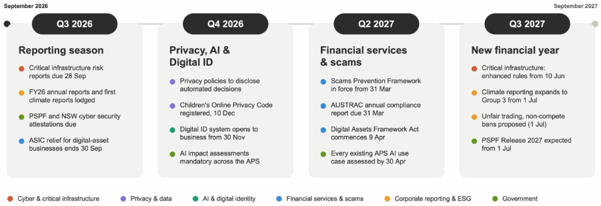
Between now and September 2027, Australian corporate and government entities face new obligations across cyber security, privacy, AI, financial services, ESG and public-sector reporting. Most of them arrive in four windows. Plan around those and the year becomes manageable.
Key Regulatory and Standards Alignment Concepts
1. Obligations Before Controls
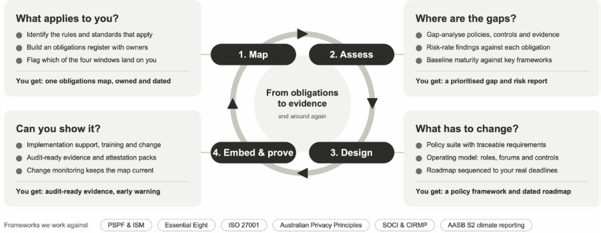
An obligations register records what applies to your entity type, who owns each obligation and when it falls due, with each obligation classified as mandatory, expected or conditional.
Every control, policy and piece of evidence traces back to a line in that register, so nothing is built that does not discharge an obligation, and no obligation is left without a home.
2. One Control Set, Many Assessors
An ISO/IEC 27001 information security management system provides the organising structure: 93 Annex A controls across organisational, people, physical and technological domains, mapped to the PSPF and ISM, the Essential Eight, APRA CPS 234, SOCI risk management obligations and the Privacy Act.
The result is a single Statement of Applicability and one set of controls that can answer a certification auditor, a regulator, an IRAP assessor and a customer’s security questionnaire alike.
3. Evidence Is the Product
Each control is defined three ways: the documented design (policies, standards, procedures, registers), the records that show it operating (logs, tickets, approvals, test results, attestations) and the test an auditor will actually perform.
Evidence is designed alongside the control and curated in a single library, so audit readiness is a standing condition rather than a project.
4. Alignment Is Continuous
Regulatory change monitoring covers the PSPF annual release, quarterly ISM updates, new legislation and the next windows on the calendar, with each change assessed, dispositioned and cascaded to the affected controls.
Annual cycles of attestations, management review, internal audit and certification surveillance keep the picture current, so the first audit is the hardest and every one after it is routine.
Benefits of Regulatory and Standards Alignment
One Compliance Picture. A single register of obligations, controls and evidence replaces parallel spreadsheets kept for each regulator, standard and audit.
Fewer Surprises. The deadlines that apply to you are visible 12 months out, with owners assigned before the window opens.
Certification with Less Rework. Controls are designed once against every relevant obligation, so ISO/IEC 27001 certification builds on what compliance already requires rather than duplicating it.
Lower Cost of Assurance. One evidence base answers internal audit, external assessors, regulators, certifiers and customer due diligence, cutting the effort spent reassembling the same proof.
Defensible Decisions. Gaps and exemptions are risk-assessed, time-bound and reported, giving boards and executives a clear view of accepted risk.
Confidence with Regulators and Customers. Attestations and certifications rest on evidence that can be produced on demand, not on assurances that a control probably works.
CTO Consulting Regulatory and Standards Alignment Services
At CTO Consulting, we provide tailored regulatory and standards alignment services that take organisations from a fragmented view of their obligations to one control set they can maintain, certify and prove. Our work is delivered by business analysts who bring requirements discipline and traceability to compliance work.
Why Choose CTO Consulting for Regulatory and Standards Alignment?
Proven Across Government and Financial Services. We designed and delivered an integrated ICT policy framework for a large Commonwealth agency, mapping more than 5,000 obligations across 14 policies with full traceability to the PSPF.
Fluent in the Frameworks. Our consultants work daily with ISO/IEC 27001:2022 and all 93 Annex A controls, ISO/IEC 42001, the PSPF and ISM, the Essential Eight, APRA CPS 230 and CPS 234, the SOCI Act and CIRMP Rules, the Australian Privacy Principles and the Australian Sustainability Reporting Standards.
Business-Analysis Led. Requirements discipline (BABOK, Volere, BPMN) applied to compliance work means every obligation, control and piece of evidence is traceable, testable and owned.
Government-Ready. Security-cleared consultants with experience across government, financial services, health, retail, telecommunications and utilities.
Living Instruments, Not Binders. You keep the obligations register, compliance calendar, Statement of Applicability and evidence library, so alignment continues to work after the engagement ends.
Get Started with CTO Consulting
By partnering with CTO Consulting, your organisation can replace fragmented compliance efforts with one obligations map, one control set and one evidence base that satisfies regulators, certifiers and customers alike.
Learn how our Regulatory and Standards Alignment services can prepare you for the year ahead.