
Uncover where legacy structures block agility – and how to rewire for modern delivery.

Most IT leaders I speak with have already bought the tools. The new ITSM platform is live. The team has been through ITIL 4 training. There is a service catalogue, a CMDB in varying states of health, and a dashboard of SLA metrics that are mostly green.
And yet the business still describes IT as slow. Change still takes weeks. Incidents still bounce between teams. The maturity assessment you ran last year shows the same scores as the one before it.
The problem is rarely the tools or the process documentation. It is the operating model underneath them: how teams are structured, how work is funded, who owns what, and how decisions get made. You cannot bolt modern service practices onto a structure designed for a different era and expect them to stick. The structure wins every time.
The symptoms you have learned to live with
Legacy operating models rarely announce themselves. They show up as friction that everyone has quietly accepted as ‘just how IT works’:
Tickets that ping-pong. An incident touches the service desk, then infrastructure, then the app team, then a vendor, with each handover adding a day and nobody owning the outcome.
A change advisory board (CAB) that meets weekly to approve changes it cannot properly assess. Low-risk, repeatable changes wait in the same queue as genuinely risky ones.
Projects that ‘go live’ and then belong to no one. The project team disbands, operations inherits something it didn’t design, and technical debt starts accruing on day one.
Metrics that look good and feel bad. SLAs are met, yet satisfaction is low, because you’re measuring ticket handling rather than business outcomes.
Improvement that depends on heroes. A few people know how everything really works, and every initiative routes through them.
If several of these sound familiar, more process will not fix them. They are structural.
Five places legacy structures block agility
1. Teams organised by technology, not by service
The classic IT organisational structure has a network team, a server team, a database team, an applications team and a service desk. Each is efficient at its own layer. But customers do not consume layers; they consume services like payroll, the customer portal or onboarding.
When no team owns a service end to end, every problem becomes a coordination problem. Accountability fragments, and the service desk becomes a switchboard rather than a resolution point.
2. Project funding that ends at go-live
When money is allocated to projects with a start and end date, teams are rewarded for delivering scope, not for running a healthy service. Once the budget closes, attention does too. Operational costs, enhancements and debt reduction compete for scraps in a separate business-as-usual (BAU) budget.
The result is a constant cycle of build, neglect and eventual replacement, instead of continuous improvement of the services the business relies on.
3. Plan, build and run as separate worlds
Many IT functions still separate the people who design solutions, the people who build them and the people who support them. Each handover loses context. Operations is handed services it had no say in, and builders never feel the pain of what they’ve shipped.
Modern delivery depends on tight feedback loops. A wall between build and run removes them.
4. Governance built for control, not flow
Teams usually add approval layers for good reasons, often after a bad outage. Over time, these layers accumulate. Every change, purchase or architectural decision goes up the chain, regardless of risk.
This concentrates decisions with the people furthest from the work, slows everything to the pace of the busiest approver, and teaches teams that the safest move is to ask permission rather than take ownership.
5. Measuring activity instead of value
Ticket volumes, SLA attainment and project milestones are easy to count. They are also largely internal measures. They tell you how busy IT is, not whether the business is better off.
When the operating model measures activity, people optimise for activity. Tickets get closed rather than problems solved, and projects ship on time without anyone checking whether they delivered the benefit.
How to rewire for modern delivery
Rewiring does not mean tearing up the organisational structure overnight. It means deliberately shifting each of those five structures towards flow, ownership and outcomes.
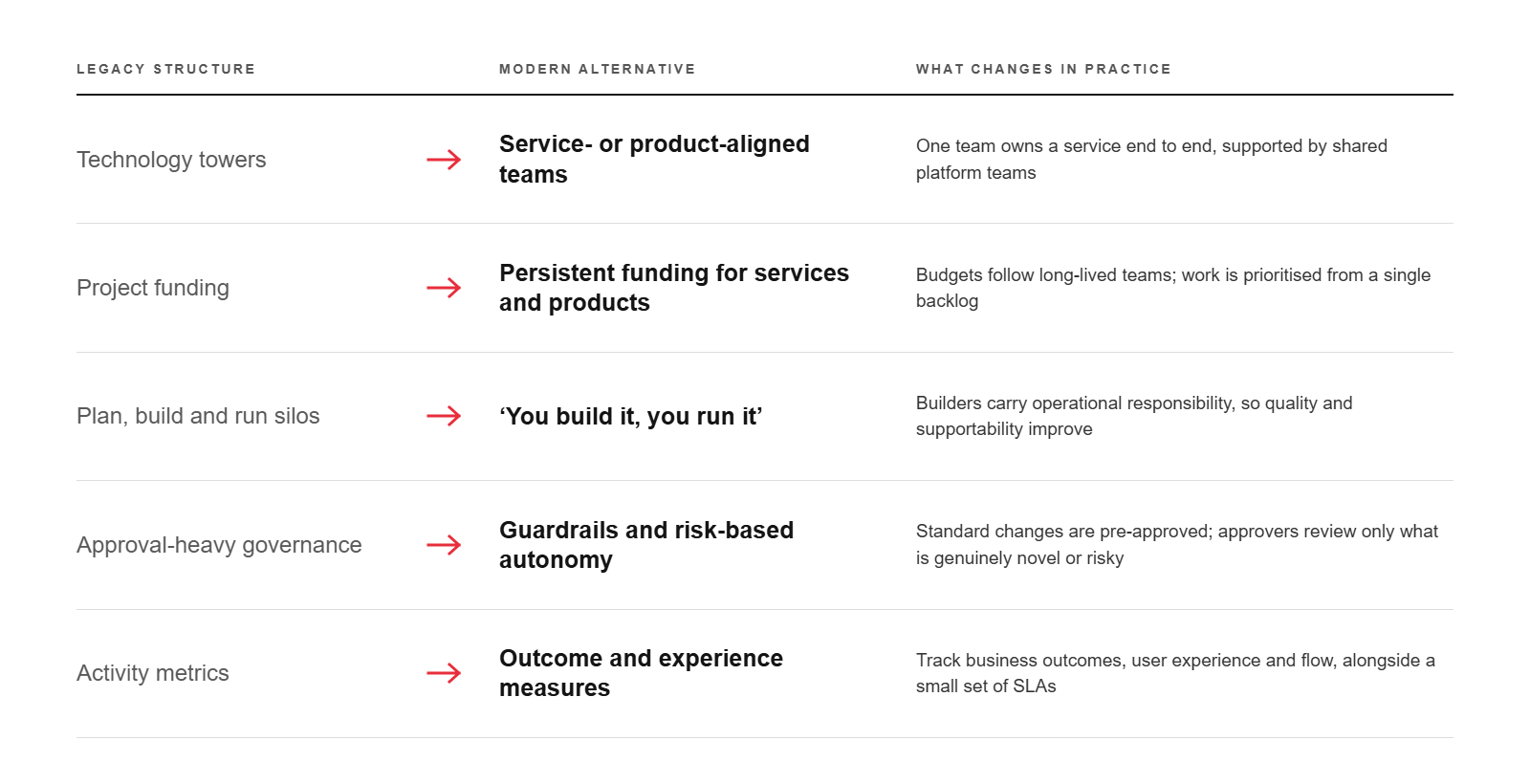
A few principles make the shift work:
Start from the service, not the structure. Map your most important business services first, then ask who would need to sit together to own each one.
Keep the shared capabilities shared. Not everything should be decentralised. Networks, identity, security and core platforms often work best as internal platform teams that make service teams faster.
Push decisions to where the information is. Define clear guardrails, then trust teams to act within them. Reserve escalation for exceptions.
Make the service desk a resolution engine. Invest in knowledge, automation and shift-left practices so more issues are solved at first contact.
Treat the operating model as a product. Iterate on it. Review what’s working each quarter, rather than launching a once-a-decade restructure.
Where to start: a practical first 90 days
You do not need a big-bang transformation to make progress. A focused 90 days can prove the model and build momentum.
Days 1–30: Diagnose. Pick two or three critical business services. Trace how work actually flows through them: every handover, approval and queue. Talk to the people doing the work and the people receiving it. The goal is a clear picture of where the structure creates delay.
Days 31–60: Pilot. Form one service-aligned team around a single service. Give it a clear owner, its own backlog and a defined set of guardrails. Move standard changes for that service to a pre-approved path.
Days 61–90: Measure and decide. Compare lead times, resolution times and stakeholder satisfaction against the baseline. Capture what got in the way. Then decide where to scale next, and what funding or governance changes are needed to support it.
The pilot matters less for its results than for what it reveals. It will surface exactly which policies, budgets and reporting lines need to change before the model can scale.
The bottom line
IT service maturity is not something you can buy, train or document your way into. It shows up in how work flows, and your operating model shapes how work flows.
If your maturity scores have plateaued despite real investment, look beneath the tools and processes. Ask who owns each service end to end, how it’s funded, and how many approvals stand between a good idea and a satisfied customer. The answers will tell you where to rewire first.
Want a fresh perspective on what’s holding your operating model back? Contact CTO Consulting for an operating model review.