AI Operating Model
Turning AI Investment into returns your organisation can measure

What is an AI Operating Model?
An AI Operating Model is the organisational design that turns AI capability into business value. It sets out how AI is organised, governed, funded and measured across your organisation, and how work is redesigned so that people and AI deliver better outcomes together.
Most organisations now use AI, but far fewer can point to a measurable return. McKinsey & Company’s The state of AI in 2026: On the road to ROI found that nearly nine in 10 organisations use AI in at least one business function, yet only around six per cent attribute five per cent or more of their earnings before interest and taxes (EBIT) to it. Those leaders are set apart less by their technology than by how they use it: nearly three-quarters have fundamentally redesigned their workflows around AI.
AI tools will change many times over the coming years, but the capabilities that turn them into value will not. An AI Operating Model builds those capabilities by applying proven disciplines such as business architecture, process and organisational design, governance, change management and benefits realisation.
Key AI Operating Model Concepts
1. Start with the Business Problem, Not the Tool
AI is a family of capabilities, not a single product. Generative assistants and conversational AI assist people. Intelligent automation and computer vision automate work. Predictive analytics and agentic AI decide and act.
Each solves a different business problem, so every initiative starts with the outcome it must deliver. Research and advisory firm Gartner expects more than 40 per cent of agentic AI projects to be cancelled by the end of 2027, citing escalating costs, unclear business value and inadequate risk controls.
2. An Operating Model Designed for AI
Designing an AI-ready future state deserves the same rigour as any organisational redesign, across six dimensions: strategy and value, processes, people and organisation, data and technology, governance and risk, and funding and performance.
End-to-end processes are redesigned, not automated as-is, with clear human-AI hand-offs. Roles, skills and decision rights are built for human-AI teams.
The prerequisites come first: executive sponsorship, trusted and well-governed data, plus policies and controls aligned to Australia’s Guidance for AI Adoption and ISO/IEC 42001, the international standard for AI management systems.
3. The Right Model for Organising AI
How you organise AI capability matters as much as which tools you buy. There are four broad models:
Centralised. A Centre of Excellence owns AI strategy, delivery and risk. This model is strong on control and consistency. It is best for early stages and regulated sectors.
Hub-and-spoke. A central hub sets standards and platforms while business units deliver. This model balances control and speed. It is best for scaling across the enterprise.
Decentralised. Each business unit builds and runs its own AI. This model is fast and close to customers but risks duplication and shadow AI. It is best for mature, diverse organisations.
Partner-led. Specialist partners deliver and run AI as a service. This model offers fast access to skills and scale. It is best for smaller organisations and fast starts and can complement any model.
The right choice reflects your scale, regulatory exposure, available skills and risk appetite. Many organisations start centralised and move to hub-and-spoke as their capability matures, revisiting the model as the organisation learns.
4. Quick Wins Fund the Journey
AI value sits on a spectrum from light-touch improvement to organisational transformation. Quick wins such as AI assistants, knowledge search and document processing cost little and pay back within months, but their gains are modest and easily copied.
Process redesign needs more investment and multiplies the return, while organisational transformation demands the most investment and patience and creates the most durable advantage.
AI is managed as a staged portfolio, not a collection of pilots, with a target operating model as the north star, so early returns help fund the longer transformation.
5. Return on Investment Managed, Not Assumed
Benefits are defined before money is spent and tracked until they show up in the results, with every initiative linked to a measurable outcome, an accountable owner and a baseline of current performance.
The business changes that unlock the value are identified up front, because technology without new ways of working delivers nothing.
Evidence-based stage gates stop, scale or redirect investment, so fewer pilots stall and the portfolio funds itself.
What Are the Benefits of the Right AI Operating Model?
Measurable Return on Investment. Every AI initiative is tied to a baselined outcome and an accountable owner, so the return is reported, not assumed.
A Portfolio That Funds Itself. Quick wins pay back within months and free up budget and capacity for the process redesign and transformation that create lasting value.
Fewer Stalled Pilots. Evidence-based stage gates direct investment to what works and stop what will not deliver, before more money is spent.
Clear Accountability. Roles, structures and decision rights for human-AI work are designed deliberately, so every AI outcome and risk has an owner.
Confident, Responsible Adoption. Governance aligned to Australia’s Guidance for AI Adoption and ISO/IEC 42001 gives your board, regulators and customers confidence in how AI is used.
Capability That Outlasts the Tools. Investment in data, governance, skills and change capability keeps paying off as AI technology changes.

What AI Operating Model Services Does CTO Consulting Offer?
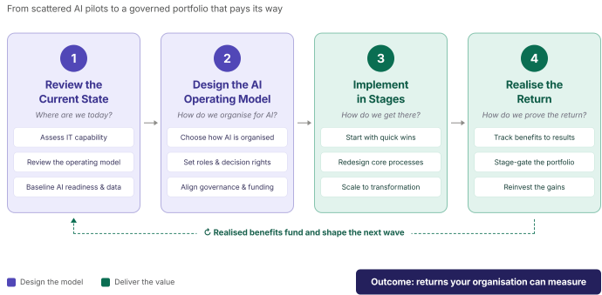
CTO Consulting provides end-to-end AI operating model services that take organisations from scattered AI pilots to a governed portfolio of AI investments with measurable returns. Our consultants bring business architecture, organisational design, governance and benefits realisation discipline to AI.
Every engagement starts with our Review of IT Capability, Operating Model and AI Readiness. This objective, vendor-agnostic baseline delivers a current-state assessment, a target AI operating model, prioritised quick wins, a costed roadmap and a benefits realisation plan, each anchored to measurable outcomes. Our program, architecture and value management services then help you deliver the roadmap and realise the benefits.
Why Choose CTO Consulting for Your AI Operating Model?
Value-Led, Not Technology-Led. Every recommendation is anchored to measurable outcomes and business growth, not technology for its own sake.
Independent and Vendor-Agnostic. Our assessments and recommendations are objective and driven by your business outcomes, not by any product or platform.
Disciplines That Outlast the Technology. Our consultants apply business architecture, process and organisational design, governance, change management and benefits realisation. These are the capabilities that keep delivering value through every technology cycle.
Governance Built In. We designed and delivered an integrated information and communications technology (ICT) policy framework for a large Commonwealth agency and bring the same discipline to AI governance aligned to Australia’s Guidance for AI Adoption and ISO/IEC 42001.
From Roadmap to Results. Our program, architecture and value management services stay with you to deliver the roadmap and realise the benefits, so recommendations become measurable results.

Get Started with CTO Consulting
Partnering with CTO Consulting enables your organisation to establish a Value Management Office (VMO) that maximises strategic outcomes by aligning investments with business priorities and measurable results.
Our expert-led model embeds Lean Portfolio Management, strengthens benefits realisation, and fosters enterprise agility, delivering clearer prioritisation, stronger governance, and sustainable value while reducing delivery risk and building long-term internal capability.

-
Karim is a Business Analysis Practice Lead, project manager, and process engineer, specialising in complex enterprise transformation. He works across financial services, telecommunications, retail, and government to manage requirements, align stakeholders, strengthen governance, and deliver measurable outcomes in multi-vendor environments. Karim has a special interest in artificial intelligence, regulatory compliance and business benefits realisation.
Latest Insights…